


by AdvisorAnalyst.com in collaboration with BMO Global Asset Management
Commodities, Reconsidered: From Tactical Trade to Structural Allocation
BMO’s Bipan Rai on how allocations to broad commodities exposure can serve as a meaningful strategic diversifier in traditional portfolios.

For much of the past decade, commodities have occupied an uneasy position in portfolio construction. Advisors and investors acknowledge their usefulness, but rarely their necessity—deploying them tactically during inflation scares or geopolitical flare-ups, then quietly retreating once markets normalized.
Our exploration of commodities with Bipan Rai, Head of ETF & Alternatives Strategy at BMO Global Asset Management, kicks off by pushing back on those gaps in misperception. Institutions, he points out, have never treated commodities as optional. They’ve viewed them as structural, strategic diversifiers—assets that earn their keep not by being clever, but by behaving differently when stocks and bonds stop doing what they’re supposed to do.
In today’s environment, Rai argues, that institutional logic is becoming relevant again—by necessity, not preference.
What is happening to traditional diversification?

A World That’s Repricing Structure, Not Just Markets
Rai frames the renewed relevance of commodities as part of a deeper shift—not a temporary macro scare.
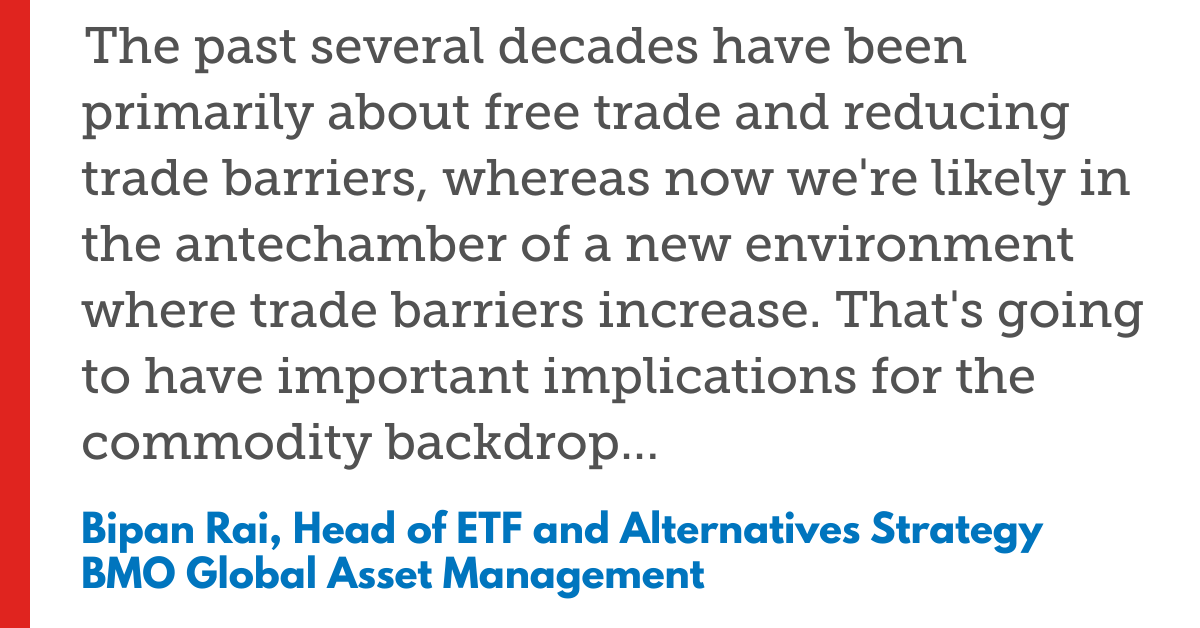
“The international trade regime that you and I have been accustomed to for the past several decades is now becoming more and more fractured… we’re certainly in the antechamber of something new and different.”
The geopolitical turbulence that opened 2026—trade tensions, sanctions risk, pressure around strategic resources—doesn’t look like noise to him. It looks like transition. A move away from frictionless globalization toward a more defensive world where access to inputs matters as much as financial conditions.
In moments like that, investors tend to look for assets that sit outside financial promises.
“Time and time again we’ve seen investors… flock towards safe havens… gold and silver and of course other commodities as well.”
But this isn’t just about fear. The bigger issue is what’s happening to diversification itself.
Tip: Tune into audio callouts
In the current climate, what are the benefits of rebalancing portfolios to international equities?
When the Ballast Stops Working
For decades, bonds have been the stabilizer in balanced portfolios. That role depends on one assumption: when equities struggle, fixed income behaves differently.
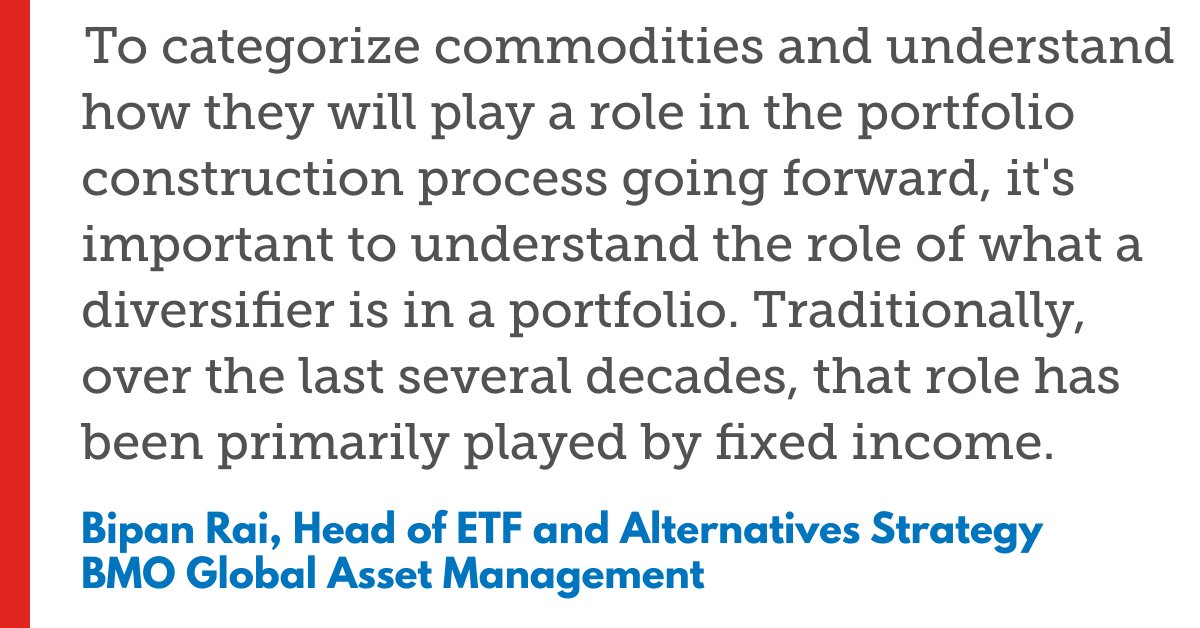
Rai explains why that assumption breaks down in inflationary regimes.
“Empirically we know… this is a regime where you see a greater degree of correlation between equities and fixed income.”
When inflation sticks around, both stocks and bonds can end up moving defensively at the same time. The classic 60/40 portfolio loses its shock absorber right when it’s needed most.
“All of a sudden fixed income does not provide that ballast that it used to… that’s a massive headache for portfolio managers.”
That’s the gap commodities step into—not because they always go up, but because they move to a different rhythm.
What actually drives commodities returns?
What Actually Drives Commodity Returns
Commodities don’t trade on earnings forecasts or central bank rhetoric. Their drivers are far more basic—and far more physical.
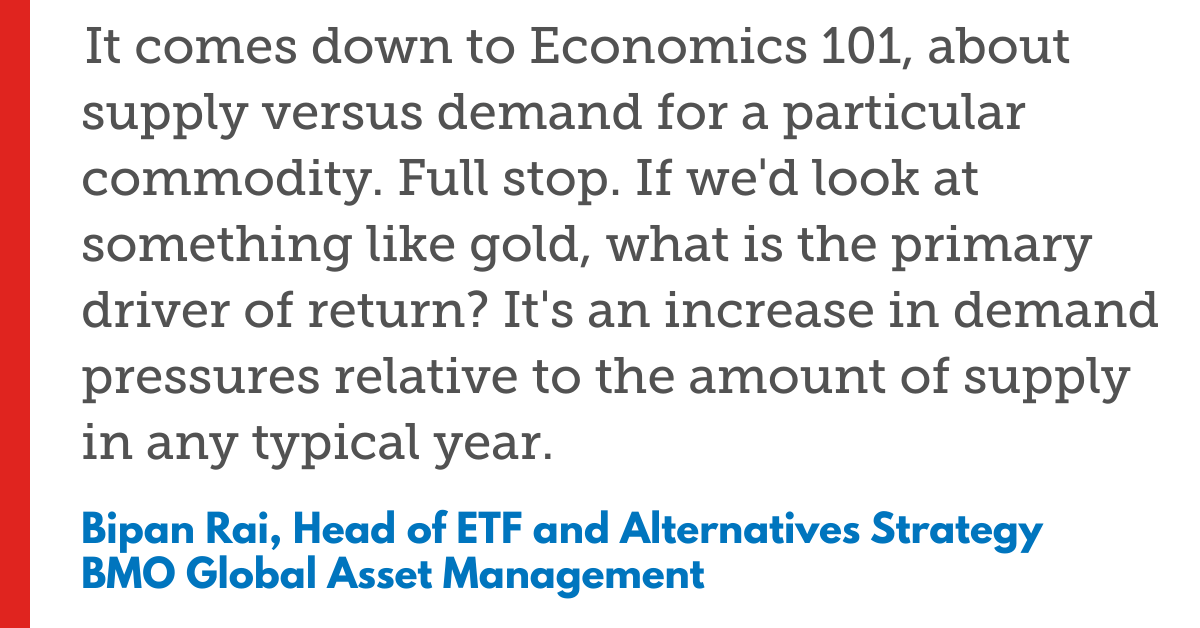
“It really comes down to the basics… supply versus demand for a particular commodity. Full stop.”
Demand can shift quickly. Investment flows change. Central banks rebalance reserves. Governments stockpile inputs. Supply, on the other hand, moves slowly.
“Mining… can’t be scaled up on demand. This takes years and years of planning and permits.”
That imbalance is crucial in inflationary environments. When price pressures come from real-world constraints—energy shortages, trade barriers, climate disruptions—financial assets react indirectly. Commodities react immediately.
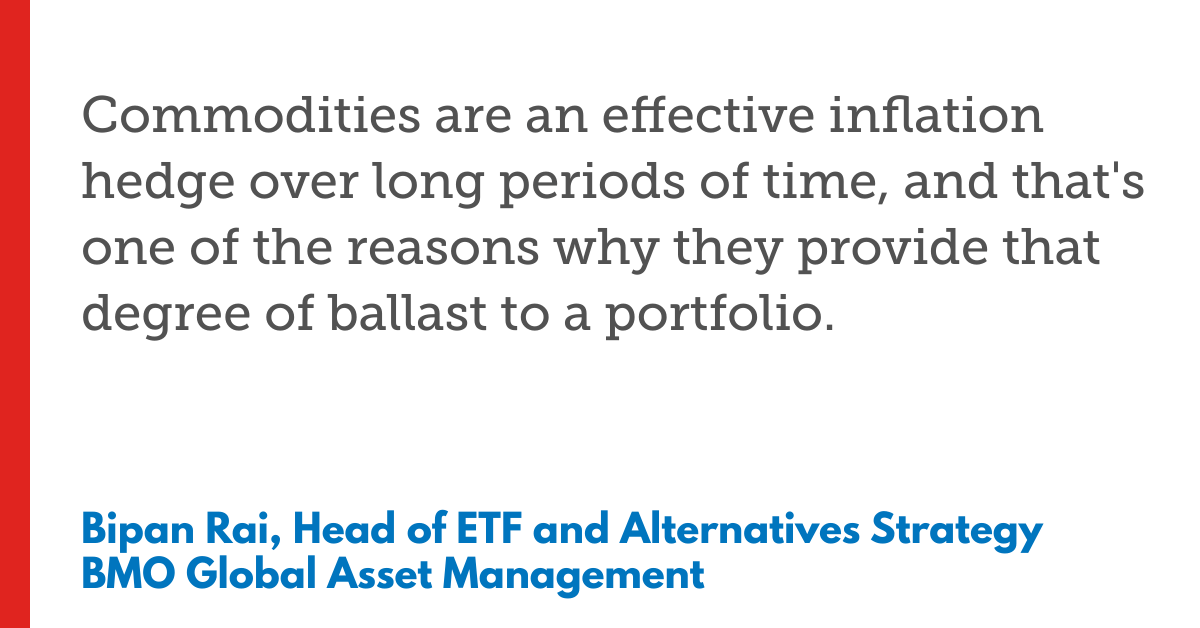
That’s why commodities aren’t really “inflation hedges” in the traditional sense. They’re inflation participants. They sit upstream of CPI, where inflation is created, not downstream where it’s measured.
How do commodities hedge against different types of inflation?
How can everyday investors access commodity markets?
Access Matters: Why Structure Beats Proxies
For most investors, commodities used to be hard to own properly. Futures markets, roll mechanics, margin requirements—it was a lot to manage unless you were an institution.
That’s changed.
ETFs have opened the door to institutional-style access, especially when they track diversified commodity benchmarks rather than single commodities or producer stocks.
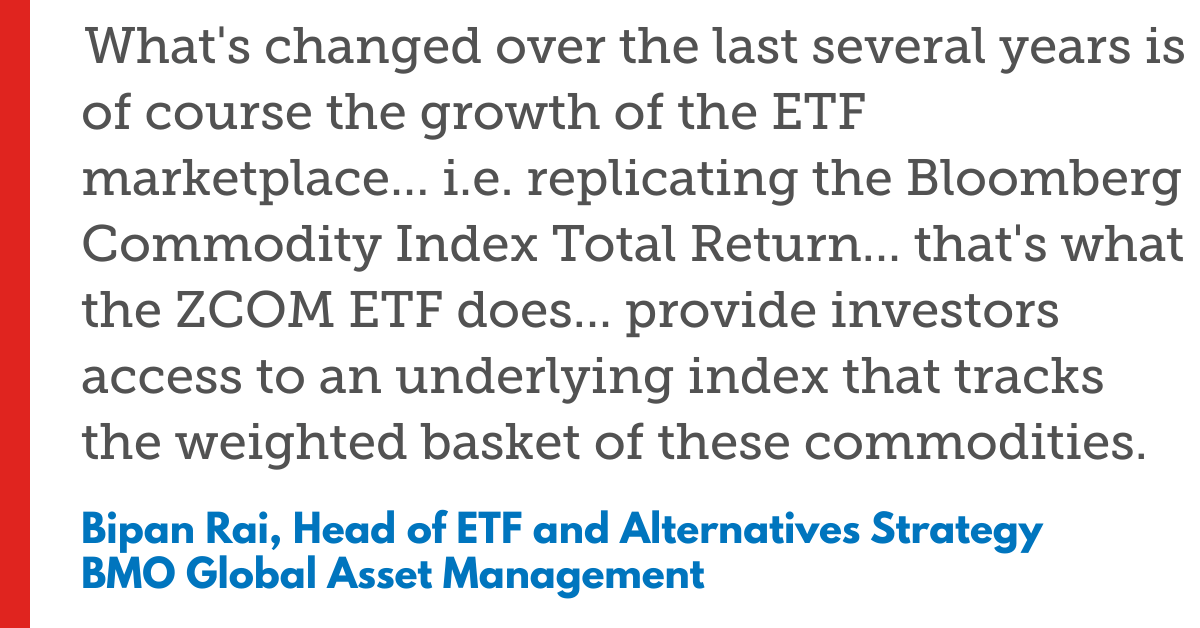
This is where ZCOM, the BMO Broad Commodity ETF, fits naturally into the conversation. ZCOM gives Canadian investors access to a broad basket of commodities by tracking the Bloomberg Commodity Index Total Return—a benchmark institutions have long used to express diversified commodity exposure.
Instead of guessing which commodity will matter next, or which producer will execute best, ZCOM lets portfolios participate in the commodity system itself—across energy, metals, agriculture, softs, and livestock.
In a world defined by uncertainty, access to the system matters more than precision bets on outcomes.
What's the better diversifier? Commodities or commodities producers/miners?
Why Producer Stocks Are a Poor Substitute
Many investors—especially in Canada—assume they already “own commodities” through mining and energy stocks. Rai draws a firm line here.
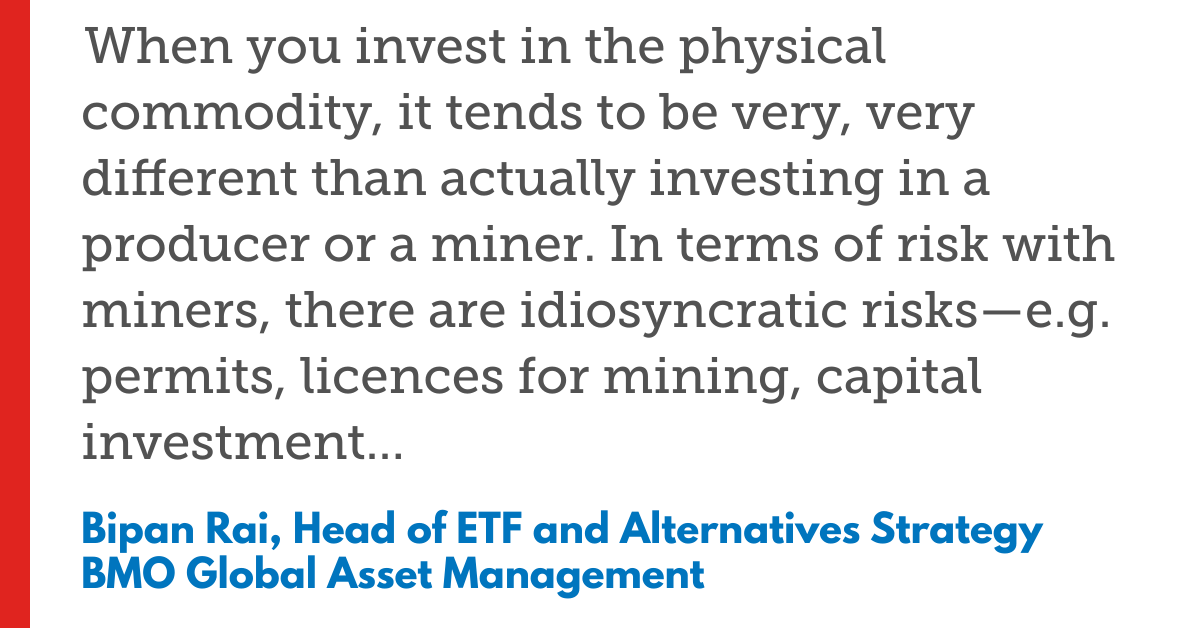
“When you invest in the physical commodity, it tends to be very, very different than actually investing in a producer or a miner.”
Producer stocks come with layers of risk that have little to do with the commodity price: operating costs, capital discipline, permitting delays, political risk, balance sheets.
“Those are questions that add a certain degree of risk and make the companies a higher beta play relative to the actual commodity itself.”
In calm markets, that leverage can help. In stressed markets, equity beta tends to dominate. Producer stocks behave like cyclical equities first—and commodity exposure second.
Direct commodity exposure strips those layers away. It removes company-specific noise and restores the diversification role investors are actually looking for.
Why Breadth Matters More Than Precision
Commodities aren’t one trade. They’re many markets moving for different reasons.
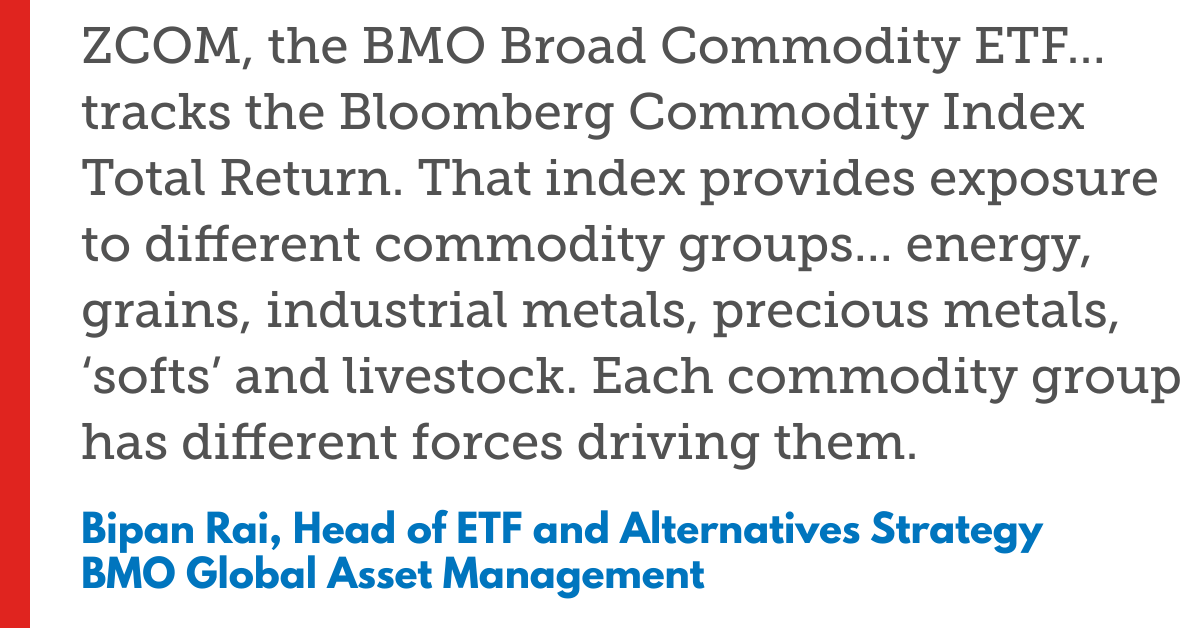
“All of those commodity groups have different forces that are driving them.”
Energy reacts to geopolitics. Industrial metals follow trade and infrastructure cycles. Agriculture responds to weather and export rules. Precious metals reflect trust—or lack of it—in monetary systems.
Trying to pick the “right” commodity means getting all of that right at once. Broad exposure takes a different approach: it lets portfolios absorb shocks wherever they show up.
That’s the real advantage of tracking a benchmark like the Bloomberg Commodity Index Total Return. Through ZCOM, investors gain exposure to commodity groups whose cycles rarely line up—reducing the need for perfect timing and increasing resilience.
“Having that broad diversification within each of the commodity groups adds that level of risk mitigation to the portfolio.”
Breadth isn’t dilution. It’s diversification inside the asset class itself.
Why invest in a basket instead of individual commodities?
How much should investors think of allocating to commodities?
Small Allocations, Real Impact
One of the more practical insights from our discussion is Rai’s case that since commodities respond to physical supply and demand rather than financial conditions, even modest allocations can materially improve portfolio behaviour.
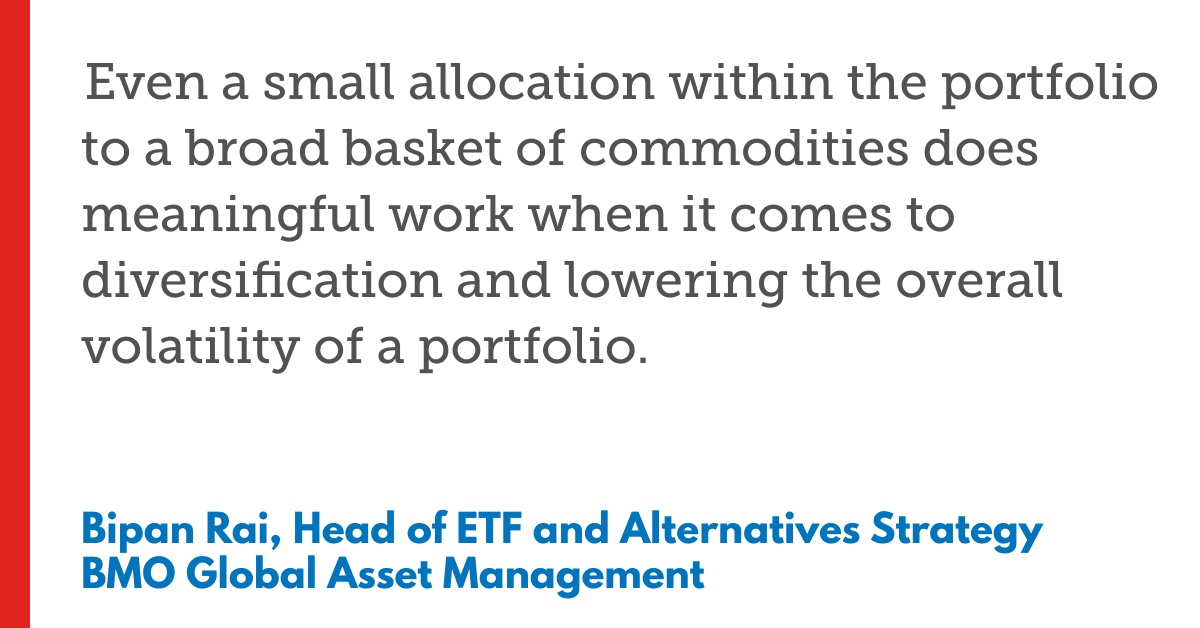
“Even if it’s in the 2% to 5% range… that does meaningful work when it comes to diversification and lowering overall volatility.”
Where that allocation comes from matters just as much.
“Any sort of allocation towards commodities… should be funded using fixed income as opposed to broad equities.”
The logic is structural. In inflationary or supply-driven regimes, bonds can lose their defensive properties as correlations with equities rise. Commodities, by contrast, tend to respond differently in exactly those environments. They are not competing with equities for returns—they are competing with bonds for diversification relevance when portfolios need it most.
How will changing trade policies impact commodities?
Commodities, Revisited
Rai’s conclusion isn’t about timing a trade. It’s about portfolio structure.
“Commodities should be an important part of investment portfolios on a go forward basis based purely on the diversification benefit and the fact that it mitigates overall volatility.”
For advisors thinking about how to express that view today, the question isn’t whether commodities belong—but how to access them cleanly.
By offering exposure to a broad basket of physical commodities through a single ETF that tracks the Bloomberg Commodity Index Total Return, ZCOM provides a practical way to apply institutional thinking—without relying on producer stocks, concentrated bets, or precise macro calls.
Commodities aren’t coming back because inflation is loud. They’re coming back because diversification is quietly failing.
For portfolios built for the next decade—not the last one—broad commodity exposure through vehicles like ZCOM may offer a more durable form of diversification than commodity producers alone.
Key Takeaways
As markets shift, advisors need to adapt their tools and strategies. Here are the main insights from our discussion:
- Commodities Are Being Repositioned, Not Rediscovered - This isn’t an inflation trade. Commodities are re-entering portfolios because traditional diversification is less reliable when stocks and bonds move together.
- Inflation Matters—but Correlation Matters More - The real risk isn’t higher prices alone; it’s losing diversification when inflation stays sticky. Commodities respond to supply and demand, not earnings or rates.
- Commodity Producers Don’t Deliver the Same Outcome - Mining and energy stocks carry equity risk. Direct commodity exposure removes company-specific noise and restores diversification when markets are stressed.
- Broad Exposure Beats Getting the Call Right - Picking the “right” commodity requires perfect timing across geopolitics, trade, and climate. Broad exposure spreads that risk and improves resilience.
- Modest Allocations Can Have Outsized Impact - Commodities don’t need to dominate portfolios. Even small allocations can smooth volatility—especially when funded from fixed income.
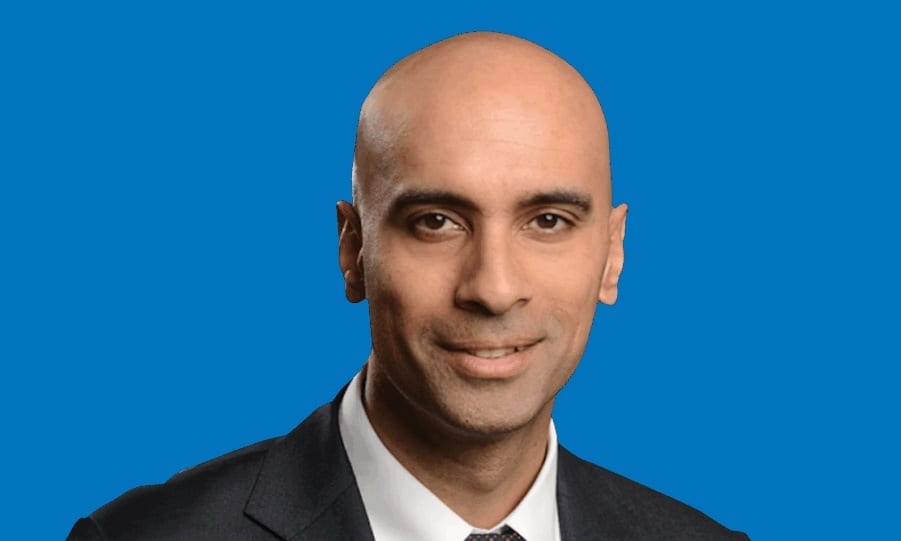
Bipan Rai
Managing Director, Head of ETF and Alternatives Strategy, BMO Global Asset Management
Bipan Rai joined BMO Global Asset Management in 2024 and currently serves as Head of ETF Strategy, delivering strategic research for the ETF and Structured Solutions team. He is highly regarded for his macroeconomic insights as well as his knowledge of market structure for various asset classes. His focus is on fundamental macro research and the implications for the ETF market place, including economic, monetary and fiscal policy analysis alongside developments in funding and liquidity. Prior to joining BMO GAM, Bipan spent 13 years as a top-ranked strategist at a large Canadian dealer. He has won several awards for his research from various publications (Greenwich Survey, Bloomberg) and is a regular contributor to global business media outlets (BNN/Bloomberg, CNBC, WSJ). He holds an MBA from the Schulich School of Business at York University and a Bachelor of Engineering degree (Aerospace Engineering) from Toronto Metropolitan University.
About BMO Financial Group
BMO Financial Group is the seventh largest bank in North America by assets, with total assets of $1.5 trillion as of October 31, 2025. Serving clients for 200 years and counting, BMO is a diverse team of highly engaged employees providing a broad range of personal and commercial banking, wealth management, global markets and investment banking products and services to approximately 13 million clients across Canada, the United States, and in select markets globally. Driven by a single purpose, to Boldly Grow the Good in business and life, BMO is committed to driving positive change in the world, and making progress for a thriving economy, sustainable future, and stronger communities.

Important Disclaimer
BMO Global Asset Management is a brand name under which BMO Asset Management Inc. and BMO Investments Inc. operate.
The portfolio holdings are subject to change without notice. They are not recommendations to buy or sell any particular security.
Commodity-linked derivative instruments are financial contracts whose value is derived from the price of an underlying commodity.
A futures contract is a standardized legal agreement to buy or sell a specific asset at a predetermined price at a specified time in the future.
The BMO Broad Commodity ETF is an exchange-traded alternative mutual fund within the meaning of NI 81-102. As an alternative mutual fund, the BMO ETF has the ability to invest in asset classes and use investment strategies that are not permitted for conventional mutual funds, including the ability to invest in other alternative mutual funds, employ leverage and borrow cash to use for investment purposes and increased ability to invest in commodities. While these strategies will be used in accordance with the BMO ETF’s investment objective and strategies, during certain market conditions, they may accelerate the pace at which an investor’s investment decreases in value.
Any statement that necessarily depends on future events may be a forward-looking statement. Forward-looking statements are not guarantees of performance. They involve risks, uncertainties and assumptions. Although such statements are based on assumptions that are believed to be reasonable, there can be no assurance that actual results will not differ materially from expectations. Investors are cautioned not to rely unduly on any forward-looking statements. In connection with any forward-looking statements, investors should carefully consider the areas of risk described in the most recent prospectus.
The information contained herein is not, and should not be construed as, investment, tax or legal advice to any party. Investments should be evaluated relative to the individual’s investment objectives and professional advice should be obtained with respect to any circumstance.
“BLOOMBERG®” and the Bloomberg Index are service marks of Bloomberg Finance L.P. and its affiliates, including Bloomberg Index Services Limited (“BISL”), the administrator of the Index (collectively, “Bloomberg”) and have been licensed for use for certain purposes by BMO Asset Management Inc. (the “Licensee”). Bloomberg is not affiliated with the Licensee, and Bloomberg does not approve, endorse, review, or recommend the ETF. Bloomberg does not guarantee the timeliness, accuracy, or completeness of any data or information relating to the ETF.
Index returns do not reflect transactions costs, or the deduction of other fees and expenses and it is not possible to invest directly in an Index. Past performance is not indicative of future results.
Distribution yields are calculated by using the most recent regular distribution, or expected distribution, (which may be based on income, dividends, return of capital, and option premiums, as applicable) and excluding additional year end distributions, and special reinvested distributions annualized for frequency, divided by current net asset value (NAV). The yield calculation does not include reinvested distributions. Distributions are not guaranteed, may fluctuate and are subject to change and/or elimination. Distribution rates may change without notice (up or down) depending on market conditions and NAV fluctuations. The payment of distributions should not be confused with the BMO ETF’s performance, rate of return or yield. If distributions paid by a BMO ETF are greater than the performance of the investment fund, your original investment will shrink. Distributions paid as a result of capital gains realized by a BMO ETF, and income and dividends earned by a BMO ETF, are taxable in your hands in the year they are paid. Your adjusted cost base will be reduced by the amount of any returns of capital. If your adjusted cost base goes below zero, you will have to pay capital gains tax on the amount below zero.
Cash distributions, if any, on units of a BMO ETF (other than accumulating units or units subject to a distribution reinvestment plan) are expected to be paid primarily out of dividends or distributions, and other income or gains, received by the BMO ETF less the expenses of the BMO ETF, but may also consist of non-taxable amounts including returns of capital, which may be paid in the manager’s sole discretion. To the extent that the expenses of a BMO ETF exceed the income generated by such BMO ETF in any given month, quarter, or year, as the case may be, it is not expected that a monthly, quarterly, or annual distribution will be paid. Certain BMO ETFs have adopted a distribution reinvestment plan, which provides that a unitholder may elect to automatically reinvest all cash distributions paid on units held by that unitholder in additional units of the applicable BMO ETF in accordance with the terms of the distribution reinvestment plan. For further information, see the distribution policy in the BMO ETFs’ prospectus.
Commissions, management fees and expenses all may be associated with investments in BMO ETFs and ETF Series of the BMO Mutual Funds. Please read the ETF facts or prospectus of the relevant BMO ETF or ETF Series before investing. The indicated rates of return are the historical compounded total returns including changes in share or unit value and the reinvestment of all dividends or distributions and do not take into account the sales, redemption, distribution, optional charges or income tax payable by the unitholder that would have reduced returns BMO ETFs and ETF Series are not guaranteed, their values change frequently, and past performance may not be repeated.
For a summary of the risks of an investment in the BMO ETFs or ETF Series of the BMO Mutual Funds, please see the specific risks set out in the prospectus. BMO ETFs and ETF Series trade like stocks, fluctuate in market value and may trade at a discount to their net asset value, which may increase the risk of loss. Distributions are not guaranteed and are subject to change and/or elimination.
BMO ETFs are managed by BMO Asset Management Inc., which is an investment fund manager and a portfolio manager, and a separate legal entity from Bank of Montreal. ETF Series of the BMO Mutual Funds are managed by BMO Investments Inc., which is an investment fund manager and a separate legal entity from Bank of Montreal.
“BMO (M-bar roundel symbol)” is a registered trademark of Bank of Montreal, used under licence.
Copyright © AdvisorAnalyst.com, BMO Global Asset Management
Image/Photo: All Rights Reserved, Copyright © AdvisorAnalyst.com