


by AdvisorAnalyst.com in collaboration with Franklin Templeton Investments
The Case for Core International Equity Exposure
Michael Greenberg on How Franklin Templeton is Redefining Allocation to International Equities

For more than a decade, global equity investing rewarded a simple discipline: stay close to home, stay close to the United States, and let mega-cap leadership do the heavy lifting. It was not just convenient—it was defensible. Growth differentials, earnings leadership, capital flows, and innovation all reinforced the same conclusion.
But markets have a habit of punishing consensus.
That U.S.-centric framework is now being tested. Leadership is broadening. Valuation gaps remain. Dispersion is rising. Correlations are falling. As a result, the international equities opportunity set—largely overlooked in recent years—is beginning to reassert itself.
The question is no longer why international equities are back in the conversation. It is how investors should engage with them—intentionally, intelligently, to enhance diversification, mitigate portfolio risk, and improve portfolio resilience across market cycles..
Michael Greenberg, Senior Vice President, Portfolio Manager, and Head of Americas Portfolio Management at Franklin Templeton Investment Solutions—joined us in a conversation for this look at what ultimately connects macro regime change, portfolio construction discipline, and the role of a systematic international core equity allocation, in today’s portfolios.
Why is the rotation to international equities more durable?

From Head Fakes to Durability: Why This Cycle Looks Different
At the outset, Greenberg is quick to acknowledge investor skepticism. International equities have promised leadership before—only to disappoint.
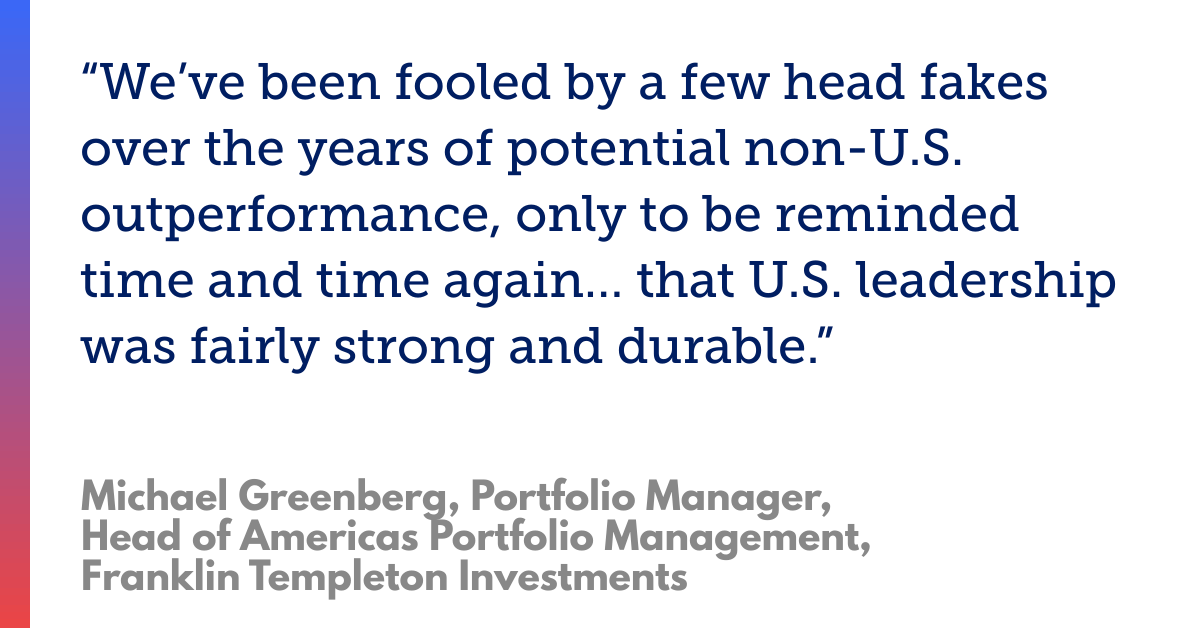
“We’ve been fooled by a few head fakes over the years of potential non-U.S. outperformance, only to be reminded time and time again… that U.S. leadership was fairly strong and durable.”
What makes the current environment different, in Greenberg’s view, is not sentiment—it is structure.
“In 2025, we did finally see a year where, although positive absolute performance coming out of the U.S. equity markets, it was one of the weaker ones globally.”
That divergence is not random. It reflects policy shifts underway across Europe, Canada, the UK, Japan, and other developed markets.
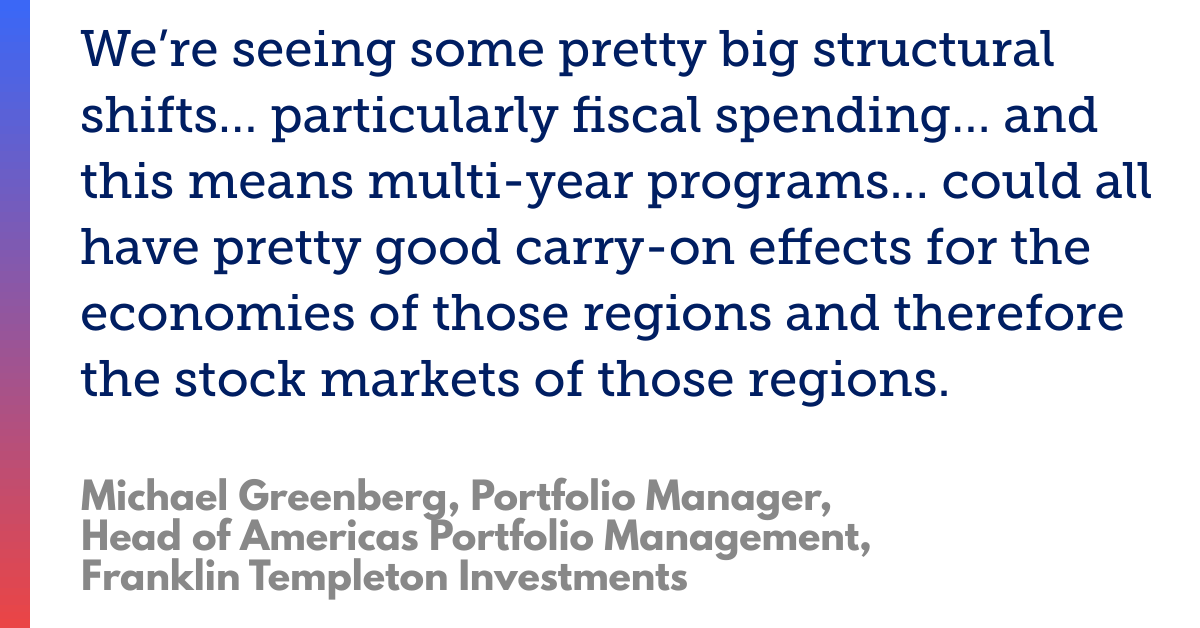
“We’re seeing some pretty big structural shifts… particularly fiscal spending… and this means multi-year programs.”
Defence spending, infrastructure investment, and productivity-enhancing initiatives are no longer cyclical stimulus—they represent a re-orientation of national balance sheets.
“That fiscal spending… could all have pretty good carry-on effects for the economies of those regions and therefore the stock markets of those regions.”
Greenberg is careful with language. It is not “different this time.” It is more durable this time.
What is contributing to the durability of the rotation to international equities?
Tip: Tune into audio callouts
In the current climate, what are the benefits of rebalancing portfolios to international equities?
The Real Risk of Staying Anchored to the U.S.
This is not an argument for abandoning U.S. equities.
“There’s still some very good reasons to remain invested in the U.S… especially tech and growth.”
The risk for advisors is not missing upside—it is maintaining portfolios built for a world where leadership remains narrow and correlations remain high.
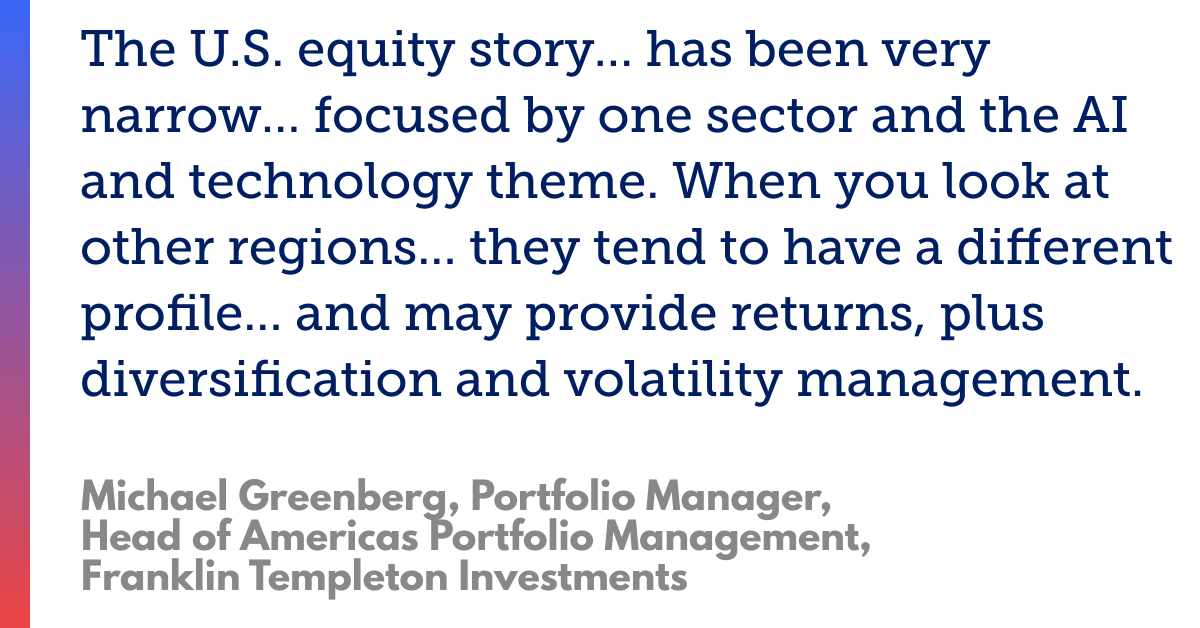
“The U.S. equity story… has been very narrow… focused by one sector and the AI and technology theme.”
By contrast, 2025 leadership outside the U.S. was dispersed:
- Canada driven by materials and gold
- Europe led by defence and financials
- Emerging markets supported by different fiscal and currency dynamics
“Not only are you typically getting geographic diversification. You’re potentially getting some good sector and industry diversification, and also investment style diversification.”
That dispersion is the mechanism through which diversification actually works.
What's making international markets potentially and relatively more attractive?
Valuations: Not a Timing Tool, but a Tailwind
Greenberg repeatedly cautions against treating valuations as a clock.
“Valuations are a terrible timing tool, but you’d rather have that at your back.”
After a year of non-U.S. outperformance, valuation gaps have narrowed—but not disappeared. They remain attractive.
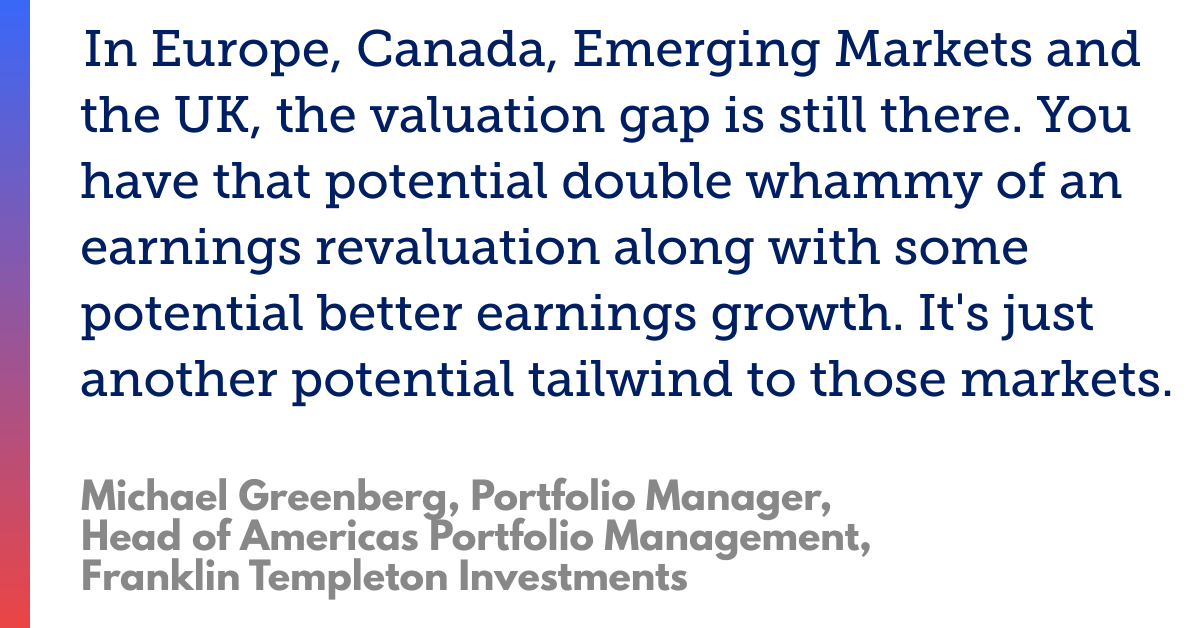
“You have that potential double whammy of an earnings revaluation along with some potential better earnings growth.”
In contrast to the U.S.—where much of the return has already come from multiple expansion—international markets still offer a combination of earnings momentum, valuation support, and higher yield profiles.
“You do tend to see a little bit higher dividend yield in places like Europe and the UK… and that is a nice component of total return.”
What are the catalysts that will potentially drive international markets higher?
Low Expectations and Catalysts
Markets priced for disappointment do not require perfection—only improvement.
“What you probably want to do is identify undervalued markets, but then think, what’s the catalyst?”
For Europe and parts of the UK, that catalyst includes fiscal investment, supply-chain re-orientation, and productivity reform.
“As investors start to see earnings momentum… capital could start to flow into those markets… and that valuation gap could start to get rectified.”
This is how leadership changes quietly—before it becomes consensus.
Why does currency exposure need to be managed deliberately?
The Dollar, Currency Risk, and Unintended Bets
Greenberg’s view on the U.S. dollar is pragmatic rather than ideological.
“We’re not in the camp of the U.S. dollar debasement trade… but it’s reasonable to expect diversification out of the U.S. dollar.”
A weaker dollar improves financial conditions globally, supports commodities, and benefits emerging markets. But currency exposure must be managed deliberately.
“What we see too often is investors thinking they’re diversified… but are taking such big currency bets that it really dominates the overall portfolio.”
Greenberg emphasizes treating currency as a separate asset class, managed at the portfolio level—not left to overwhelm equity decisions.
Falling Correlations Change the Math
Lower cross-country correlations are not a footnote—they are foundational.
“If correlations are high, it negates the whole diversification benefit… but, in a more regionalized global economy, diversification can actually improve.”
Different policy regimes, supply chains, and technology models are creating genuine economic dispersion.
“Over the long term, we’d expect to see correlations stay a little bit lower… which would be beneficial for diversification.”
What sets the Core Equity funds apart? Michael Greenberg elaborates.
Portfolio Construction Becomes the Differentiator
As dispersion rises, how portfolios are built matters more than what they hold.
Greenberg frames Franklin Templeton Investment Solutions’ approach as explicitly core–satellite.
“The systematic Core Equity funds… sit somewhere in between a passive ETF and a very high active-share manager.”
They are designed to anchor portfolios—providing beta plus disciplined factor exposure—while freeing advisors to spend risk and research budgets where it truly matters.
How does combining these 5 factors drive the International Core Equity framework?
Inside the Franklin International Core Equity Framework
The Franklin International Core Equity strategy is built on five factors:
- Quality
- Value
- Sentiment
- Alternatives
- Conviction
“Each one of these factors can stand on its own. Over a full cycle, each one of those factors will add value to the portfolio… but, key is that they tend to do so at different points in time. The Value factor has a fairly low correlation to the Quality factor, which in turn has a low correlation to the Conviction factor.”
The result is diversification within active risk.
“When you put these five factors, all of which perform on their own over a full cycle, together, what you get is a much smoother ride. You get that diversification—the synergy of those five factors working together. Importantly, what we do is dynamically manage the weights of those five factors so that they contribute equally to the risk of the overall portfolio.”
Two factors differentiate the framework:
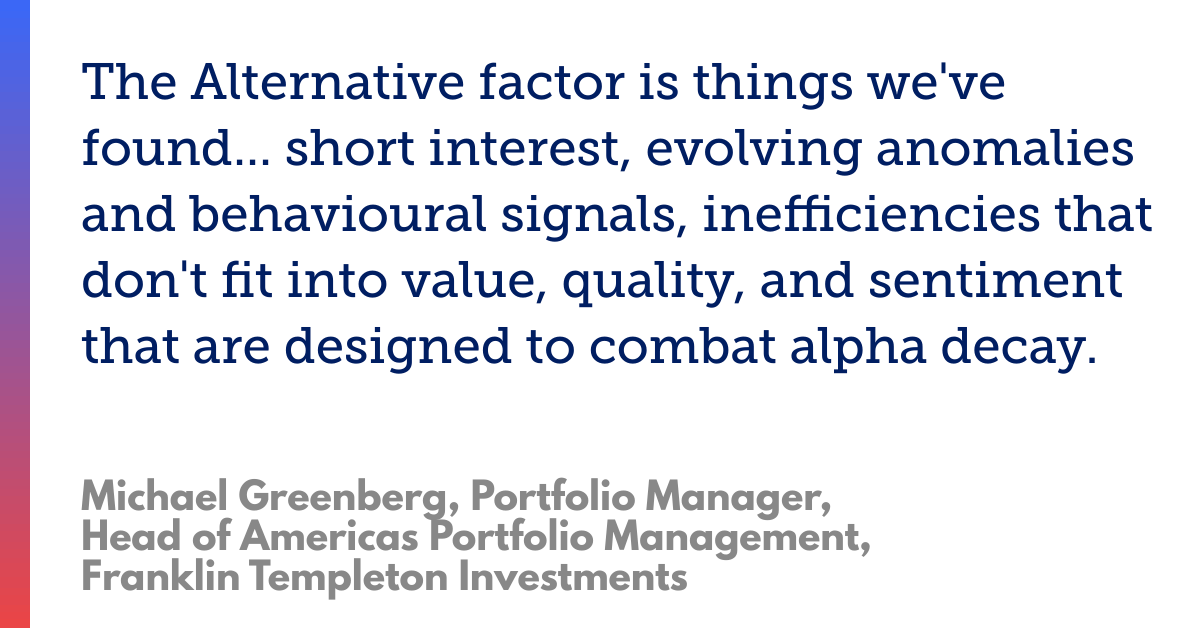
The Alternative factor captures inefficiencies that do not fit traditional definitions—short interest, behavioural signals, and evolving anomalies—explicitly designed to combat alpha decay.
“It’s continually evolving… and that’s a good thing.”
The Conviction factor is a distinct differentiator.
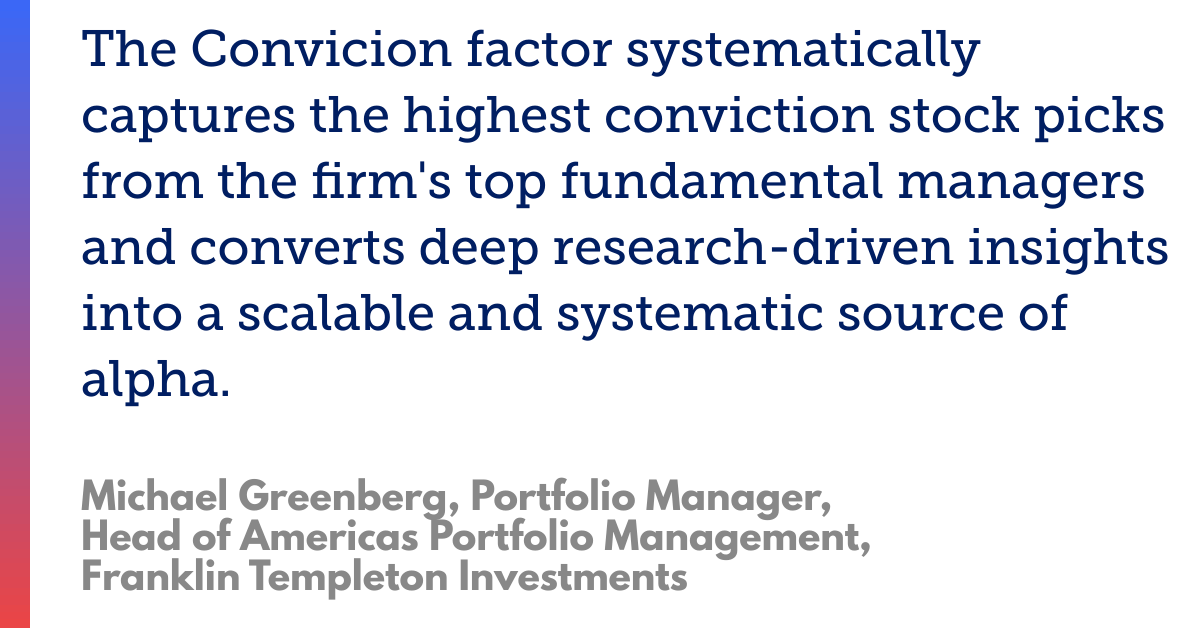
"Unique to Franklin Templeton, this factor systematically captures the highest conviction stock picks from the firm's top fundamental managers and converts deep research-driven insights into a scalable and systematic source of alpha."
Crucially, all active risk is confined to these factors.
“There are no country bets, no sector bets… all the active risk is coming from those five factors.”
What is the 'Alternative' Factor
What is the 'Conviction' Factor
What makes International Core Equity an efficient portfolio building block?
From Institutional Tool to Advisor Building Block
These multi-factor strategies were originally developed as proprietary portfolio building blocks for use within Franklin, not for retail investors.
“We created these funds seven years ago for our internal multi-asset portfolios.”
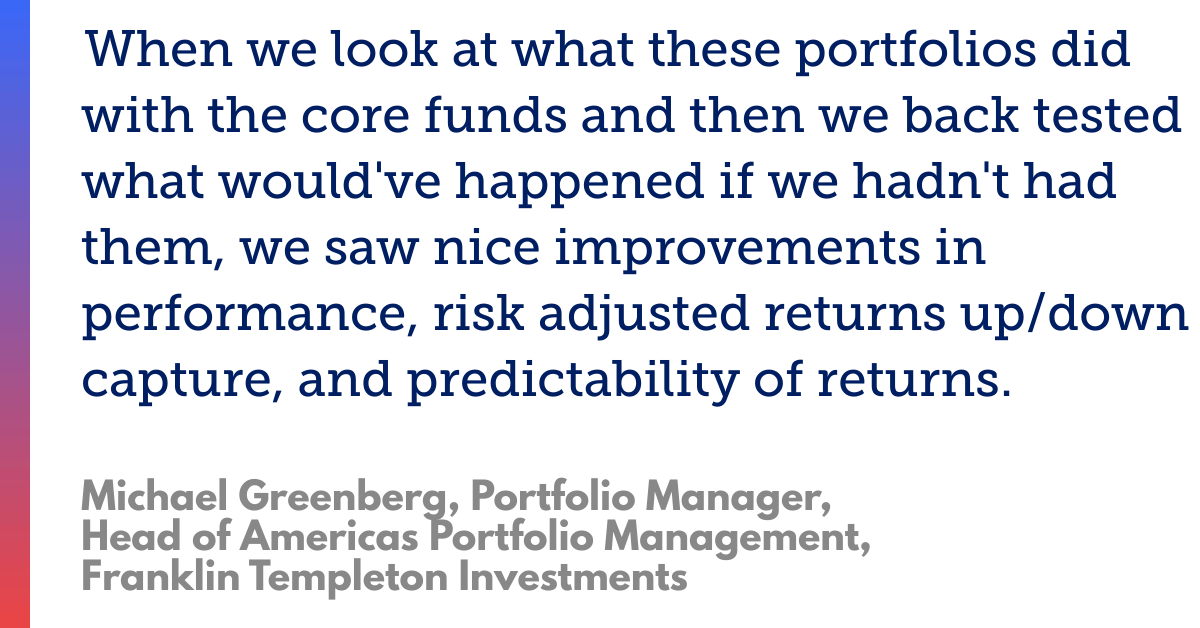
Only after demonstrating improvements in predictability, risk-adjusted returns, and drawdown behaviour were they eventually made available more broadly.
“This is not a new thing for us… but the timing of making Core Equity available more broadly is now.”
And, as fee transparency increases, the conversation changes. It’s no longer just about what you pay, but about how efficiently the strategy is working and how consistently it delivers results.
Strategic, Not Satellite
Greenberg’s conclusion is unequivocal.
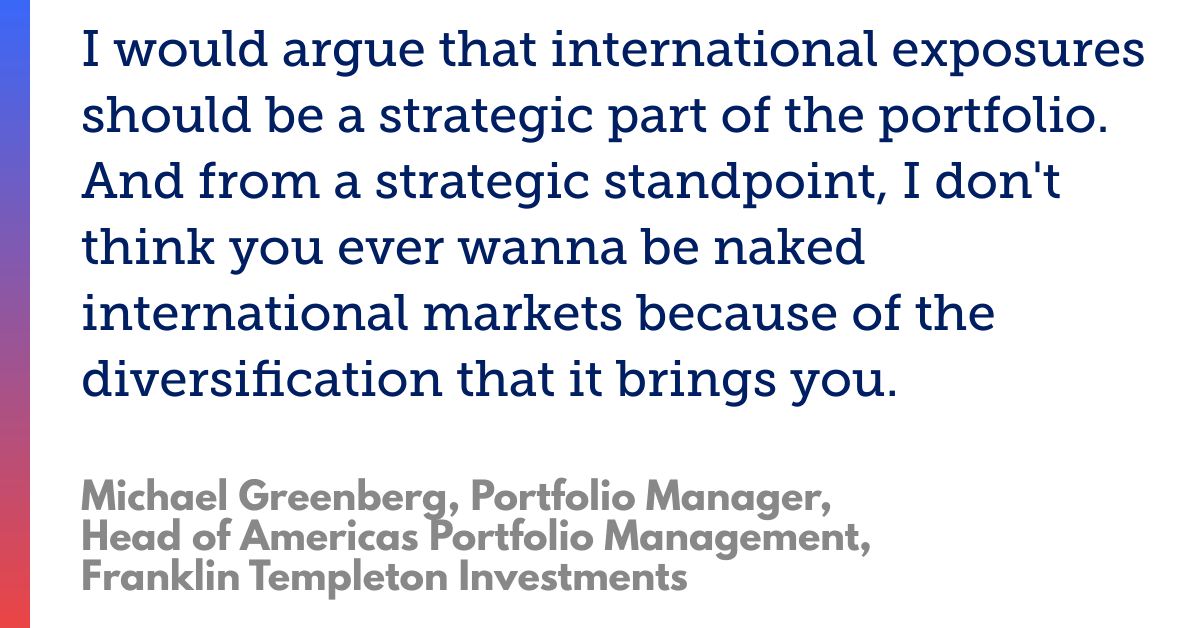
“I don’t think you ever want to be naked in international markets because of the diversification that it brings you.”
International equities belong in the strategic core of portfolios, with tactical tilts layered on top—not the other way around.
The Proof Point
“2025 is a great example… if you had diversification across U.S., Canada, international, EM… you may have just experienced a really good year.”
Not because investors predicted the turn—but because portfolios were built to withstand one.
In an era defined by fragmented leadership rather than dominance, the role of international equities is no longer theoretical. It is structural.
And the Franklin International Core Equity strategy is designed to reflect that reality—quietly, systematically, and without unintended bets.
How much of the equity sleeve should be strategically allocated to international equities?
Key Takeaways
As markets shift, advisors need to adapt their tools and strategies. Here are the main insights from the discussion:
- International is no longer optional. Fragmenting leadership and falling correlations make international equities a structural allocation, not a tactical trade.
- Concentration is the real risk. U.S. returns have been narrow; global returns are being driven by different sectors, styles, and policies.
- Low expectations = asymmetric upside. International markets still offer valuation support, earnings momentum, and higher income without requiring perfection.
- Structure beats prediction. In a high-dispersion world, portfolio construction—not market calls—determines outcomes.
- Core discipline matters. A systematic international core—like Franklin International Core Equity—anchors diversification while eliminating unintended bets.

Michael Greenberg
Senior Vice President, Portfolio Manager, and Head of Americas Portfolio Management
Michael Greenberg is a senior vice president, portfolio manager, and head of Americas portfolio management for Franklin Templeton Investment Solutions.
In his role, he is responsible for oversight of FTIS portfolio management in the Americas ex. US. He is a member of the team's Investment Strategy and Research Committee with a focus on fixed income. He is a portfolio manager for several funds offered for sale in various jurisdictions including Canada, the U.S., Brazil, and Mexico such as the Franklin Quotential, Franklin LifeSmart Sustainable and Franklin ETF Portfolios. He is also on the portfolio management team for Franklin Global Allocation Fund in the U.S.
Mr. Greenberg joined Franklin Templeton in 2007 and has had roles within the solutions team in manager research, investment research, and portfolio management. Prior to joining Franklin Templeton, Mr. Greenberg had roles in group retirement, business development, product development and research in the financial service industry.
Mr. Greenberg holds a bachelor of commerce degree with honors in marketing and international management from the University of Ottawa. He also holds the Chartered Financial Analyst (CFA) and Chartered Alternative Investment Analyst (CAIA) designations.
About Franklin Templeton Investments
Franklin Resources, Inc. [NYSE:BEN] is a global investment management organization with subsidiaries operating as Franklin Templeton and serving clients in over 150 countries. In Canada, the company's subsidiary is Franklin Templeton Investments Corp., which operates as Franklin Templeton Canada. In Canada, Franklin Fixed Income is a business name used by Franklin Templeton Investments Corp. Franklin Templeton's mission is to help clients achieve better outcomes through investment management expertise, wealth management and technology solutions. Through its specialist investment managers, the company offers specialization on a global scale, bringing extensive capabilities in fixed income, equity, alternatives and multi-asset solutions. With more than 1,400 investment professionals, and offices in major financial markets around the world, the California-based company has over 75 years of investment experience and approximately US$1.6 trillion (approximately CAN$2.2 trillion) in assets under management as of July 31, 2025. For more information, please visit franklintempleton.ca.

Important legal information
This material is intended to be of general interest only and should not be construed as individual investment advice or a recommendation or solicitation to buy, sell, or hold any security or to adopt any investment strategy. It does not constitute legal or tax advice.
The views expressed are those of the investment manager, and the comments, opinions, and analyses are rendered as at publication date and may change without notice. The information provided in this material is not intended as a complete analysis of every material fact regarding any country, region, or market.
All investments involve risks, including possible loss of principal. Please note that an investor cannot invest directly in an index. Unmanaged index returns do not reflect any fees, expenses or sales charges. Past performance is no guarantee of future results.
International investments are subject to special risks including currency fluctuations, social, economic and political uncertainties, which could increase volatility. These risks are magnified in emerging markets.
Commissions, trailing commissions, management fees, brokerage fees, and expenses may be associated with investments in mutual funds and ETFs. Please read the prospectus and fund fact/ETF facts document before investing. Mutual funds and ETFs are not guaranteed. Their values change frequently. Past performance may not be repeated.
Franklin Templeton Canada is a business name used by Franklin Templeton Investments Corp.
Copyright © AdvisorAnalyst.com, Franklin Templeton Investments
Photo credit: Photo by Alessio Rinella on Unsplash